
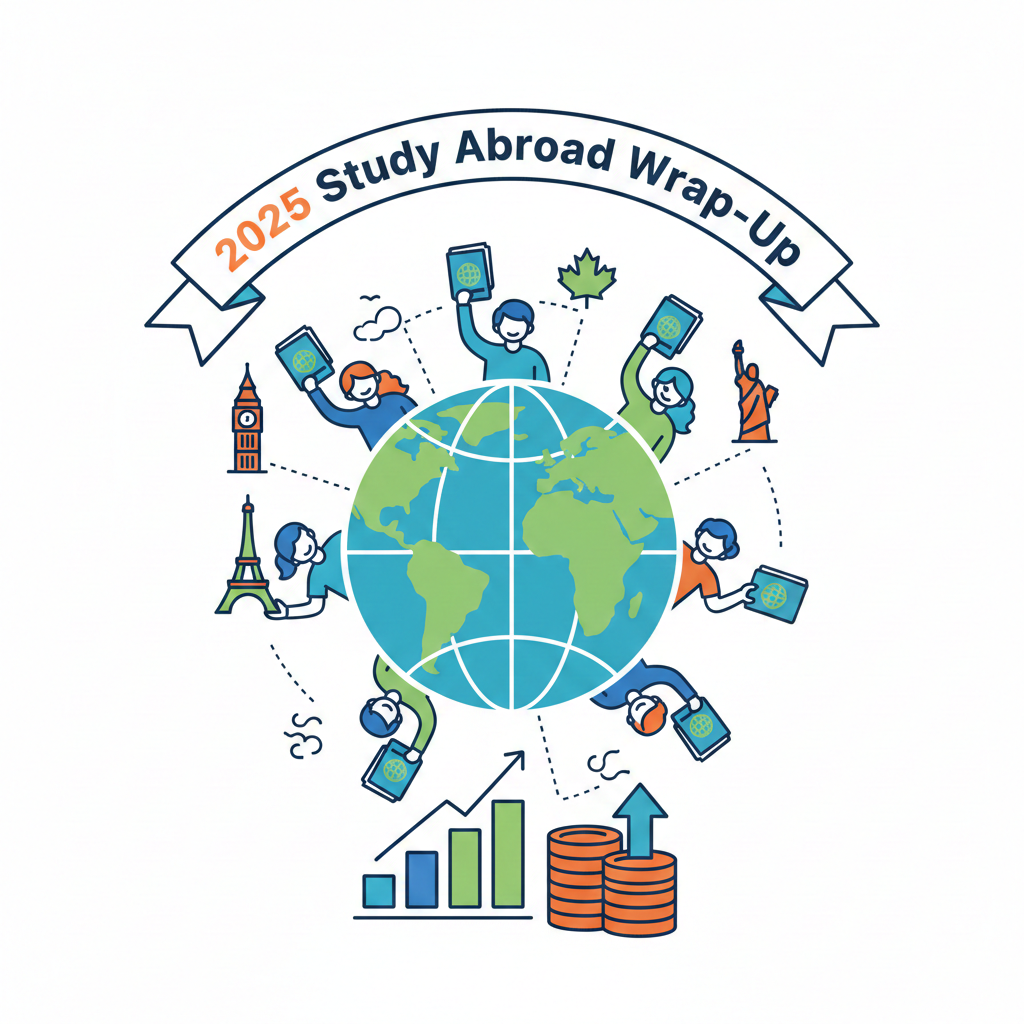
As we close out 2025, the landscape for international education has undergone a historic transformation. For Indian students—the world’s most mobile student cohort—the “Big Four” (USA, UK, Canada, and Australia) have shifted from open-door policies to a more regulated, “quality-over-quantity” approach.
Here is your essential wrap-up of the policy changes and trends that defined 2025.
1. Canada: The End of the “Open Door” Era
2025 marked a definitive tightening of Canadian immigration. The government implemented a strict cap of 437,000 study permits, a 10% reduction from 2024 levels.
• Masters & PhDs Included: For the first time, graduate students are now part of the national cap and require Provincial Attestation Letters (PAL).
• Work Rights: Post-Graduation Work Permit (PGWP) eligibility now requires a Canadian Language Benchmark (CLB) score of 7 for university graduates. Furthermore, college graduates only qualify for PGWPs if their field of study aligns with specific labor shortages.
2. Australia: Caps and Higher Costs
Australia introduced a “National Planning Level,” capping international student commencements at 270,000 for 2025.
• Visa Fee Spike: The visa application charge saw a significant jump, making the initial investment steeper.
• Stricter Standards: The “Genuine Student” (GS) test has replaced the old GTE, with much higher scrutiny on academic intent. English proficiency requirements also rose, with the minimum IELTS score for a student visa moving from 5.5 to 6.0.
3. UK: Quality Control and Digitalisation
The UK transitioned to a fully digital e-visa system in July 2025, phased out physical BRP cards.
• Dependant Restrictions: The ban on dependants for most taught master’s students remained in place, limiting family accompanying rights to PhD and research-based programs.
• Financial Proof: In late 2025, maintenance requirements were raised to £1,483/month for London and £1,136/month elsewhere.
4. USA: A Fairer Lottery
The US focused on “integrity” in 2025. The H-1B lottery is now beneficiary-centric, meaning each student has only one entry regardless of how many employers register them, significantly reducing fraud and helping genuine Indian STEM graduates.
The “Value” Pivot: New Destinations
With rising costs and caps in traditional hubs, 2025 saw a massive surge in Indian interest toward Germany, the UAE, and New Zealand. Germany, in particular, has become the top choice for “Affordable Excellence,” with its tuition-free public universities now hosting nearly 60,000 Indian students.
Key Takeaway: 2026 will be the year of the “Strategic Applicant.” Success no longer depends just on getting an admit, but on choosing a course that aligns with specific visa-eligible career paths.